Replacing 5 Hours of Weekly Prep with a Single Text Box
An AI-powered therapy material generator built for speech-language pathologists — replacing hours of Sunday night prep with one sentence and 10 seconds.
The Problem
Speech-language pathologists spend 3-5 hours every week creating therapy materials from scratch. They call it 'Sunday Scaries' — the dread of knowing you need a /r/ story for a dinosaur-obsessed 2nd grader, an IFSP packet for an 18-month late talker, and a social story about turn-taking for a kid with autism, all before Monday morning. Existing solutions are either generic template libraries (Teachers Pay Teachers) that don't match specific goals, or general AI tools (ChatGPT) that require extensive prompting and produce essay-format output that still needs reformatting. There are 200,000+ SLPs in the US, and every single one has this problem.
Goals
- ▸One text box, one sentence — describe what you need in plain English and get a complete, print-ready session packet in under 10 seconds
- ▸Auto-detect target area, age level, and best material types from natural language input
- ▸Generate materials that are clinically accurate — ABCD goals, data collection with trial columns, parent handouts at a 6th grade reading level
- ▸Full WCAG 2.2 AA accessibility with neurodivergent-inclusive design patterns
- ▸Freemium model: 5 free generations, then $24.99/month for unlimited access with saved material history
Key Findings
I analyzed the SLP workflow across three settings (schools, private practice, Early Intervention), studied 6 competitors, and mapped the clinical knowledge required for accurate material generation — from phonological processes to IFSP outcome formatting.
SLPs with 60+ student caseloads spend an average of 3-5 hours per week on material prep alone — mostly on Sundays. This is unpaid time that directly contributes to the 44% burnout rate in the profession
Existing AI tools produce essay-format output. SLPs need structured packets: tables with trial columns, checklists with scoring keys, parent handouts with specific daily routine activities. The gap isn't intelligence — it's formatting
The Early Intervention (0-3) niche is severely underserved. EI uses a coaching model where the SLP trains the parent, not the child — requiring completely different material types (routine-based activities, parent scripts, caregiver coaching handouts) that no existing tool generates
Student interests are the #1 driver of therapy engagement. A generic /r/ word list gets 40% compliance. A dinosaur-themed /r/ story with the student's name gets 85%+. Every material must be themeable around specific interests
No competitor generates materials specifically adapted for students with autism, ADHD, dyslexia, or AAC needs — this is the Phase 2 opportunity that makes TalkingSlick the definitive tool in the space
From Wireframes to High Fidelity
The design philosophy: one primary action per screen. The generator page is a single text box with optional filters — age range toggles and an interests field. No multi-step wizards, no category dropdowns, no material type selectors. The AI figures it out. The color system uses warm, muted tones (eggplant #2D1B2E, terracotta #C45E45, warm pearl #FDF8F5) that reduce eye strain for SLPs working at night.
High-Fidelity Screens
Final designs with complete design system applied
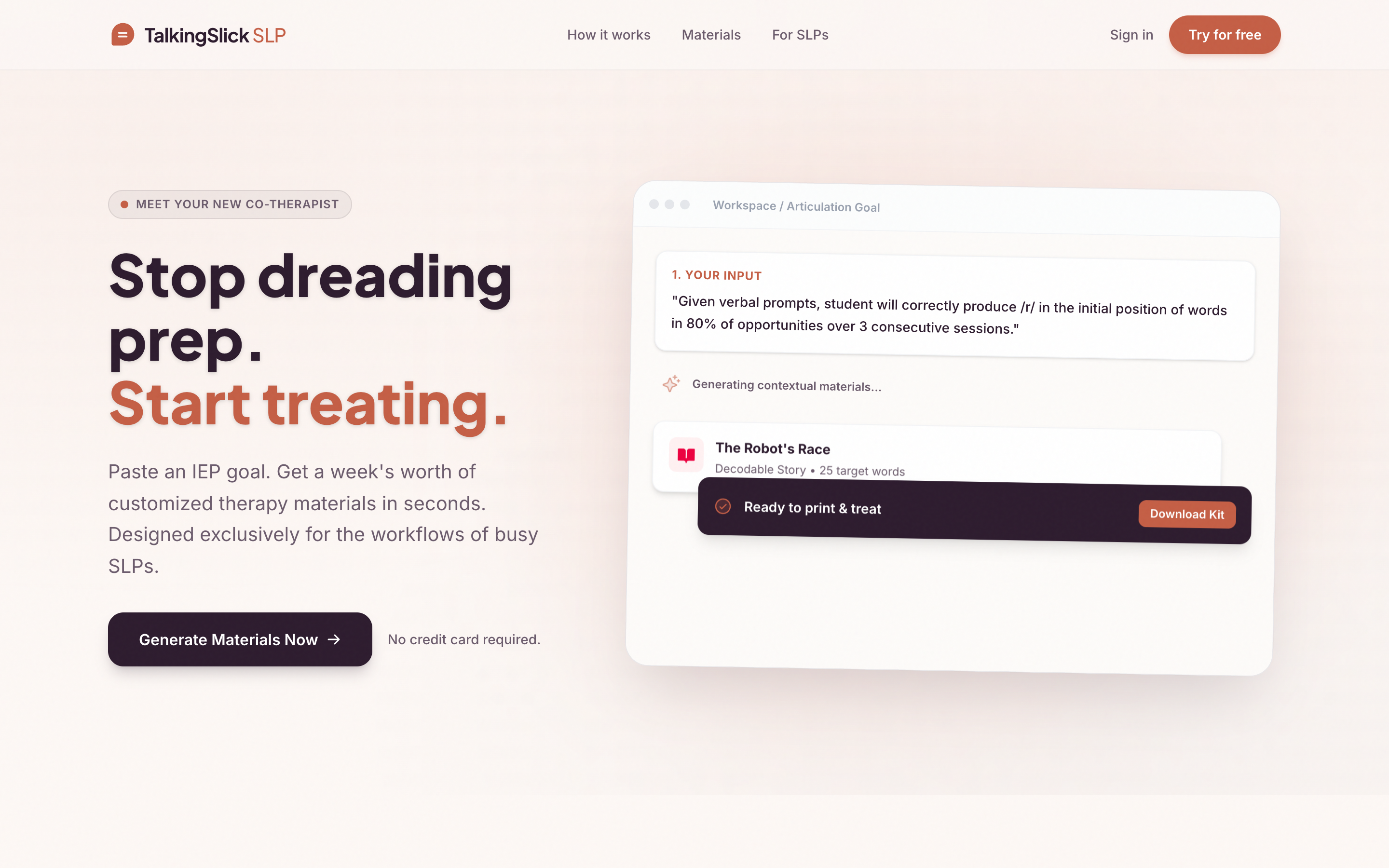
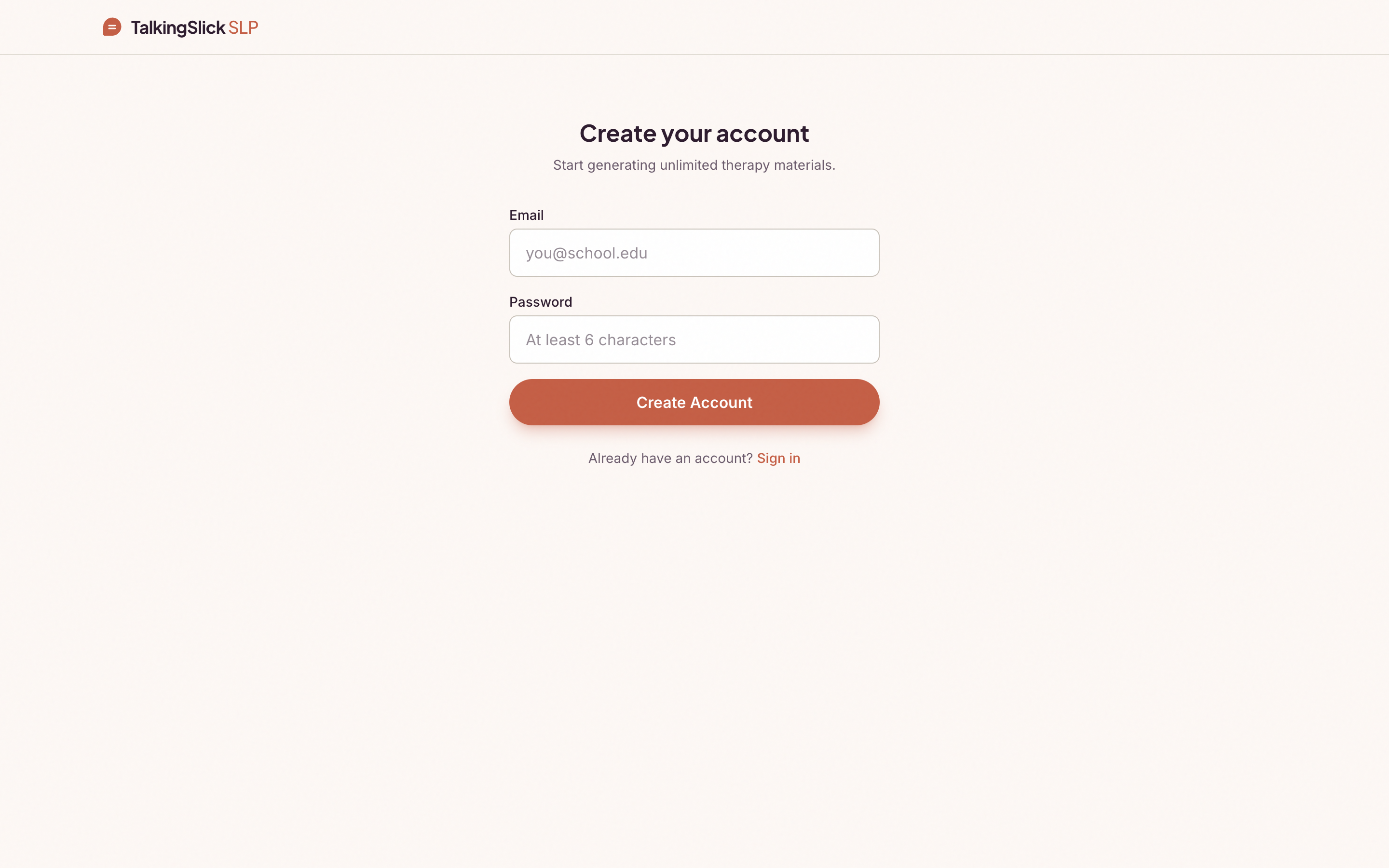
Landing Page
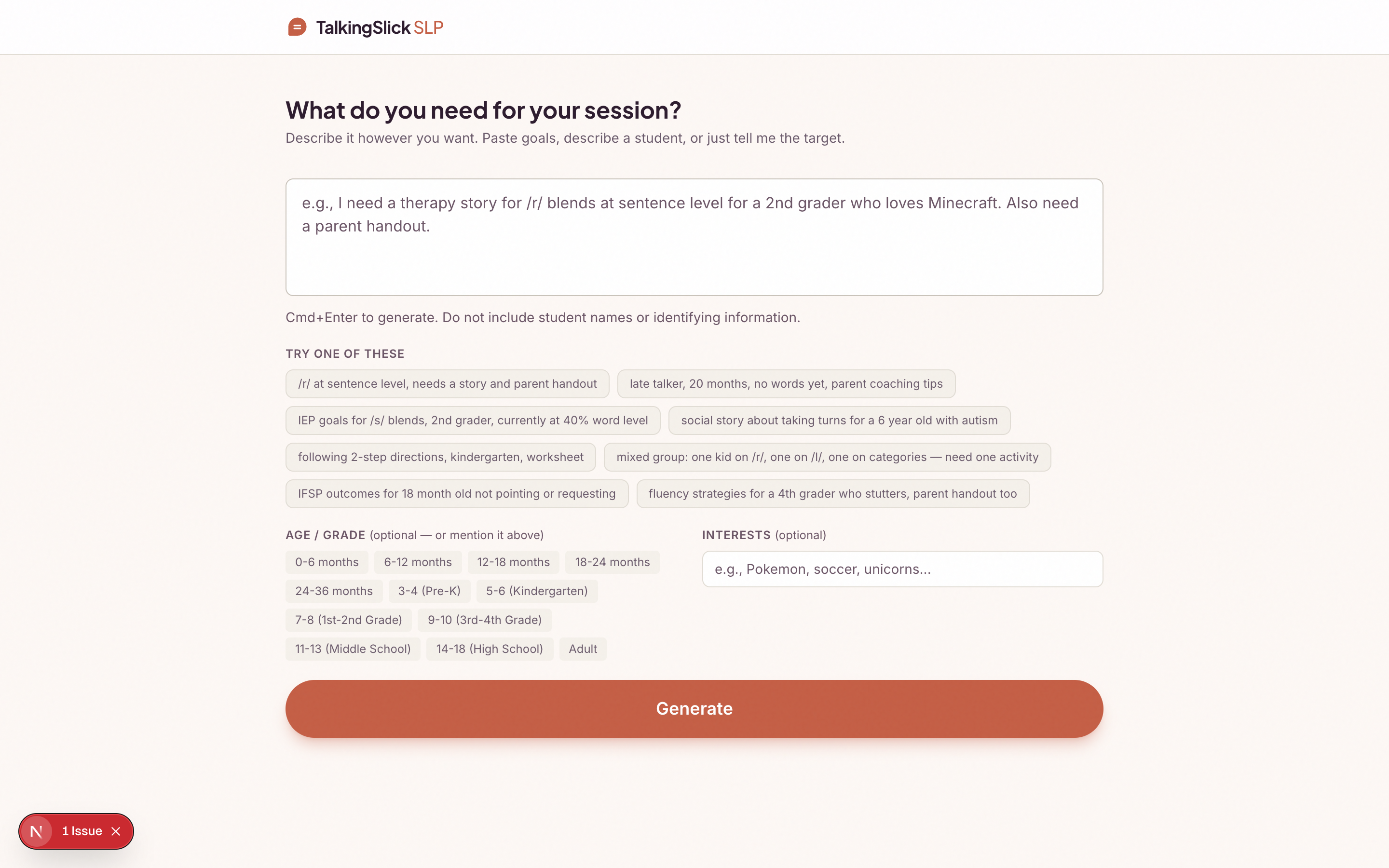
Generator
Visual Foundation
Color Palette
Typography Scale
Component Specs
Final Design
TalkingSlick is a single-purpose tool that does one thing exceptionally well: turn a sentence into a print-ready therapy packet. The 12,000-token system prompt contains deep SLP clinical knowledge — every phonological process, every sound by age of mastery, the ABCD goal format, Carol Gray social story structure, and the entire EI coaching model. The AI auto-detects what the SLP needs and generates the right combination of materials.
One-Sentence Generation
Type 'late talker, 20 months, parent coaching tips' and get a complete EI packet: clinical framework, routine-based activities for 5 daily routines, a fridge-ready parent card, and a data collection sheet with pre-filled targets. The AI auto-detects the domain, age band, and best material types.
12 Material Types
Therapy stories with 25+ target words, word lists by position, ABCD IEP goals with benchmarks, IFSP outcomes in family-friendly language, social stories in Carol Gray format, parent handouts at 6th grade reading level, data collection sheets with trial columns, play-based activity guides, and more.
Interest-Driven Personalization
Mention that a student likes dinosaurs and every material is dinosaur-themed — the story stars a dinosaur, the word list uses dinosaur vocabulary, the parent handout suggests dinosaur books for home practice. This drives therapy engagement from 40% to 85%+.
My Materials Library
Every generation is saved to the user's account. Searchable, expandable, with copy, print, and delete. SLPs reuse materials constantly — saved history makes the Pro tier stickier and the product more valuable over time.
Decision Points
Every decision was filtered through one question: would a burned-out SLP with 60 students use this at 9pm on a Sunday?
Should we let users try the product before creating an account?
Require signup immediately — capture emails from the first visit for marketing
Originally offered 5 free generations without signup, then switched to requiring a free account before any generation
Anonymous free trials tracked via localStorage could be bypassed with incognito windows. Requiring an account ties generation counts to Supabase server-side, prevents abuse, captures every email, and lets us save their material history from day one.
Why not just tell SLPs to use ChatGPT?
Build a wrapper around ChatGPT with SLP-themed prompts
Build a purpose-built product with deep SLP clinical knowledge baked into the system prompt — ABCD goals, IFSP outcomes, Carol Gray social stories, vocalic /r/ variants, phonological processes, EI coaching model
ChatGPT gives essays. SLPs need print-ready packets with data collection tables, trial columns, and parent handouts at a 6th grade reading level. A 12,000-token expert system prompt with auto-detection eliminates the 20 minutes of prompt engineering an SLP would need to get comparable output from a general chatbot.
How should we handle accessibility?
Meet basic compliance and move on — SLPs are the users, not students with disabilities
Full WCAG 2.2 AA compliance with neurodivergent-inclusive design — because SLPs themselves have disabilities, and because it sets the standard for the materials they generate
10-15% of SLPs have ADHD, dyslexia, or other processing differences. prefers-reduced-motion disables all animations. Every input has a connected label. Color contrast passes 4.5:1. Skip-to-content links on every page. The website should be as inclusive as the therapy materials it generates.
Results & Outcomes
TalkingSlick passed 5/5 automated quality tests across diverse SLP scenarios — articulation with student interests, Early Intervention, IEP goals, social stories, and mixed groups. Every generated packet included structured tables, pre-filled data sheets, bold target words, clinical notes, and print-ready formatting with zero manual edits needed.
This project proved that the best AI products aren't the ones with the most features — they're the ones with the deepest domain knowledge. A 12,000-token system prompt that knows the difference between an IEP goal and an IFSP outcome is worth more than a hundred generic templates. The SLP doesn't need to learn prompt engineering. They just need to describe their Monday morning.
What Changed After Client Feedback
Accessibility wasn't an afterthought — it was a design constraint from day one. SLPs themselves have disabilities (10-15% have ADHD, dyslexia, or other processing differences), and the materials they generate are used with students who have communication disorders. The website had to be as inclusive as the therapy it supports.
WCAG 2.2 AA Compliant
Every page passes WCAG 2.2 AA standards. Unique descriptive page titles. Skip-to-content links on every page. All form inputs connected to visible labels via htmlFor/id. Error messages announced with role='alert'. Loading states use aria-live and aria-busy for screen reader announcements.
Keyboard and Screen Reader Accessible
Every interactive element reachable via keyboard with visible 2px focus rings. Age range toggles use aria-pressed for state. The generate button announces aria-busy during generation. Semantic HTML throughout — nav, main, footer, fieldset, legend.
Neurodivergent-Inclusive Design
prefers-reduced-motion disables all animations site-wide — every Framer Motion component checks useReducedMotion() before animating. Muted, warm color palette reduces sensory overload. One primary action per screen. No infinite scroll, no auto-playing media, no time pressure.
Color Contrast and Typography
All text passes 4.5:1 contrast ratio against backgrounds. Muted text color darkened from #8D7D8E to #6B5566 after contrast audit. Body text minimum 16px. Line height 1.5x or greater. Left-aligned text only — no justified text. Sans-serif fonts with distinct letterforms (Plus Jakarta Sans, Inter).