Building the Intervention Infrastructure for IEPs and MTSS
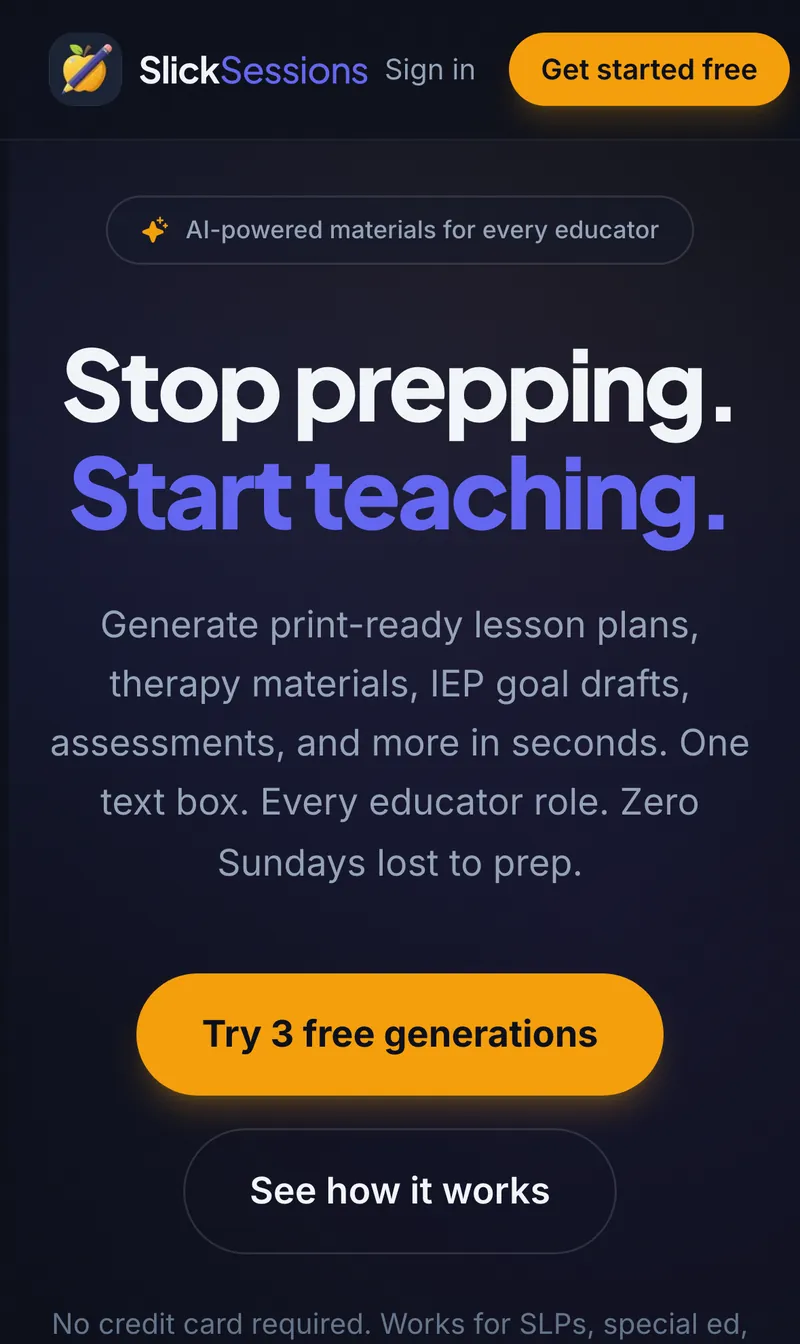
An AI-powered intervention platform for K-12 educators — 23 games and tools that close the loop from practice to data to documentation to next session.
The Problem
K-12 specialists — special ed teachers, SLPs, reading interventionists, school counselors, ENL teachers, school psychologists — spend 5-10 hours per week creating practice activities, writing IEP and MTSS documentation, and translating parent letters. The market is fragmented: MagicSchool gives them 80+ generic tools, Goalbook charges $595/year for documentation alone, IXL buys and buries every promising indie. Nothing connects the practice the student does on Monday to the IEP statement the teacher writes on Friday. Every minute of intervention data lives in a notebook or never gets captured at all.
Goals
- ▸One platform for every K-12 specialist role — same login, same student profile, same data sheet, role-specific games and documentation
- ▸Close the loop: every game auto-fills an IEP-ready data sheet, every data sheet writes its own progress note, every progress note recommends the next 3 games to play
- ▸State-aligned standards on every artifact — all 50 states + DC + PR, every grade Pre-K through 12th, no generic CCSS-only output
- ▸A free public wedge that ranks for the highest-intent search queries (PLAAFP rewrites, IEP goal writing) and converts SEO traffic to signups
- ▸WCAG 2.2 AA accessibility with neurodivergent-inclusive design as a non-negotiable standard, not an afterthought
Key Findings
Synthesized 8 deep-research domains (Special Ed, Science of Reading, ENL/WIDA, Math Intervention, General Ed Pedagogy, SEL/Behavior, Pain Point Solutions, Role Workflows) into a 22,000-token curricula brain that recognizes every major intervention program by name — Wilson Steps 1-9, Fundations K-3, Heggerty rungs, UFLI K-1, Zones of Regulation, RULER, PECS Phases, VB-MAPP, WIDA standards, BRIEF, and hundreds more.
Specialists don't want more tools — they want one tool that knows their program. A teacher running Wilson Step 5 needs games that respect closed syllables and consonant doubling, not generic phonics drills. Recognition of program-specific scaffolding is the difference between 'I tried it once' and 'I use it every day.'
Documentation is where the day dies. PLAAFPs, progress notes, parent letters, IEP goals — every specialist writes the same boilerplate hundreds of times per year. Auto-drafting from real practice data turns 45 minutes into 4.
The closed loop is the moat. Connecting practice → data → documentation → next-game recommendation increases lifetime value 2.5-5x over disconnected-tool platforms because teachers cannot extract the workflow once they're in it.
State standards matter more than CCSS. Texas teachers want TEKS, Florida teachers want B.E.S.T., New York teachers want Next Gen. Any tool that surfaces only CCSS reads as built-by-someone-who-wasn't-a-teacher.
Multilingual parent communication is the most-requested ENL feature and the most-skipped feature in competitor tools. 10 home languages covers ~95% of US K-12 multilingual learner families. Translating the letter and explaining the goal in plain language unlocks family partnership at IEP meetings.
One Design System, 23 Games and Tools
The design system carries the same warm, low-saturation palette across every game and tool — eggplant, terracotta, warm pearl. Every game uses the same DataSheet component, the same StatePicker, the same NextSteps panel. The result is a platform where a school psych and a reading teacher both feel like the product was built for them specifically. Visual content is generated through fal.ai for game illustrations and a library of 30+ custom SVG components for math/science visualizations.
High-Fidelity Screens
Final designs with complete design system applied
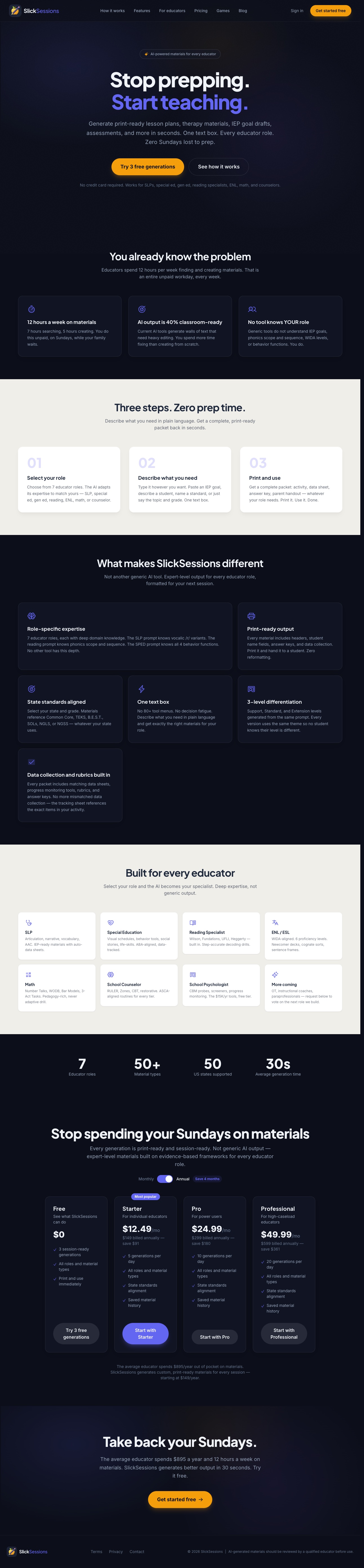
Homepage
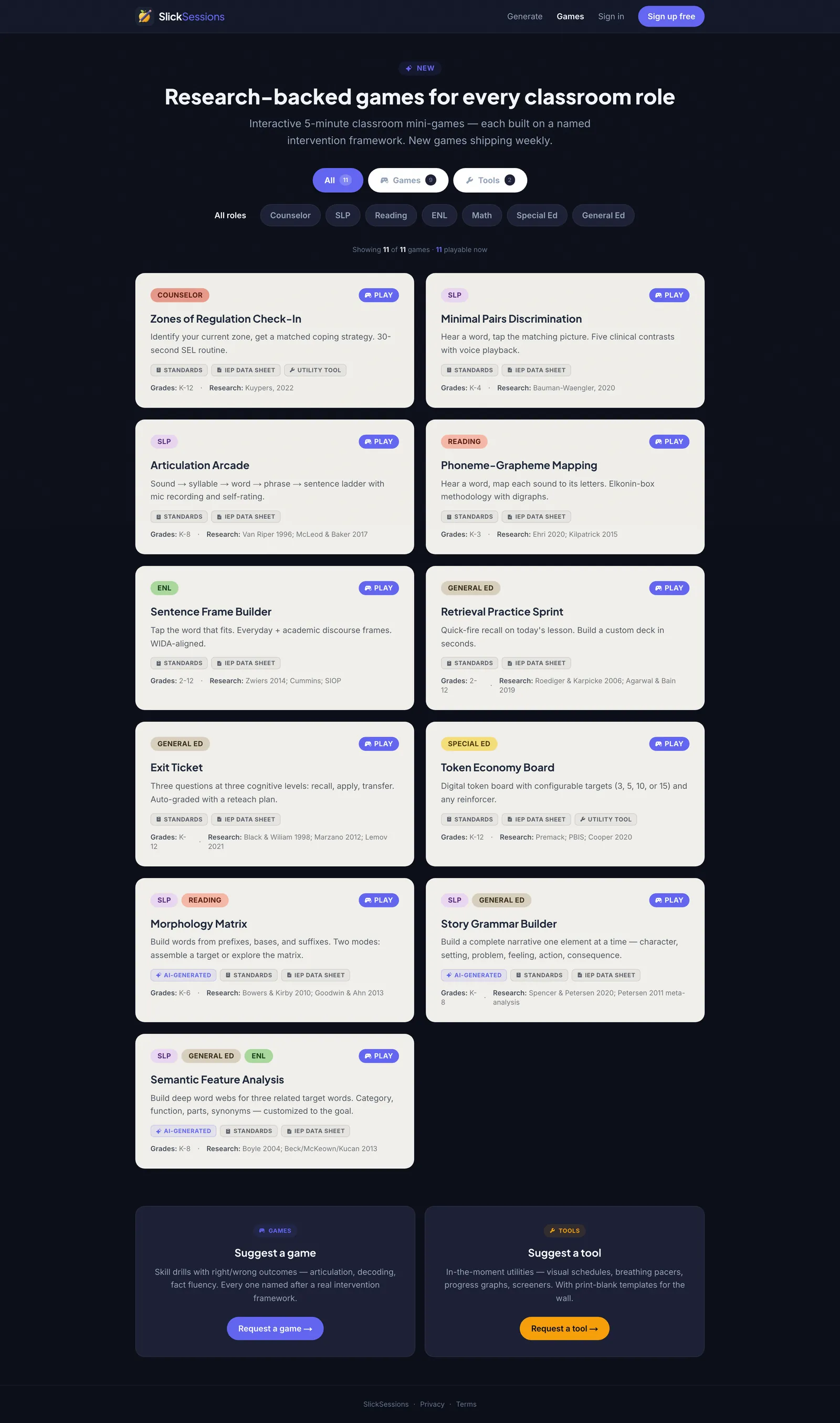
Games & Tools Hub
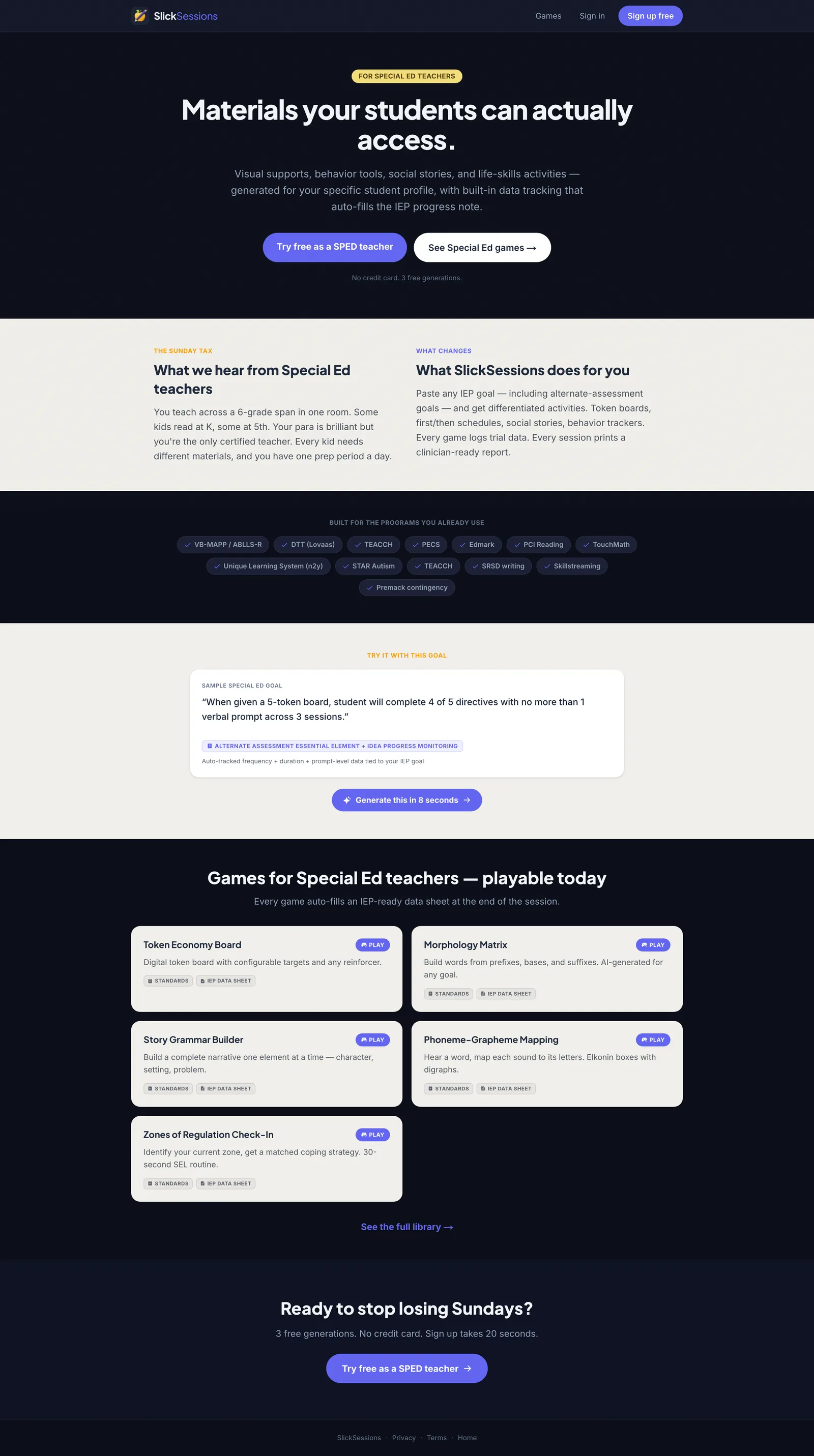
/for/special-ed
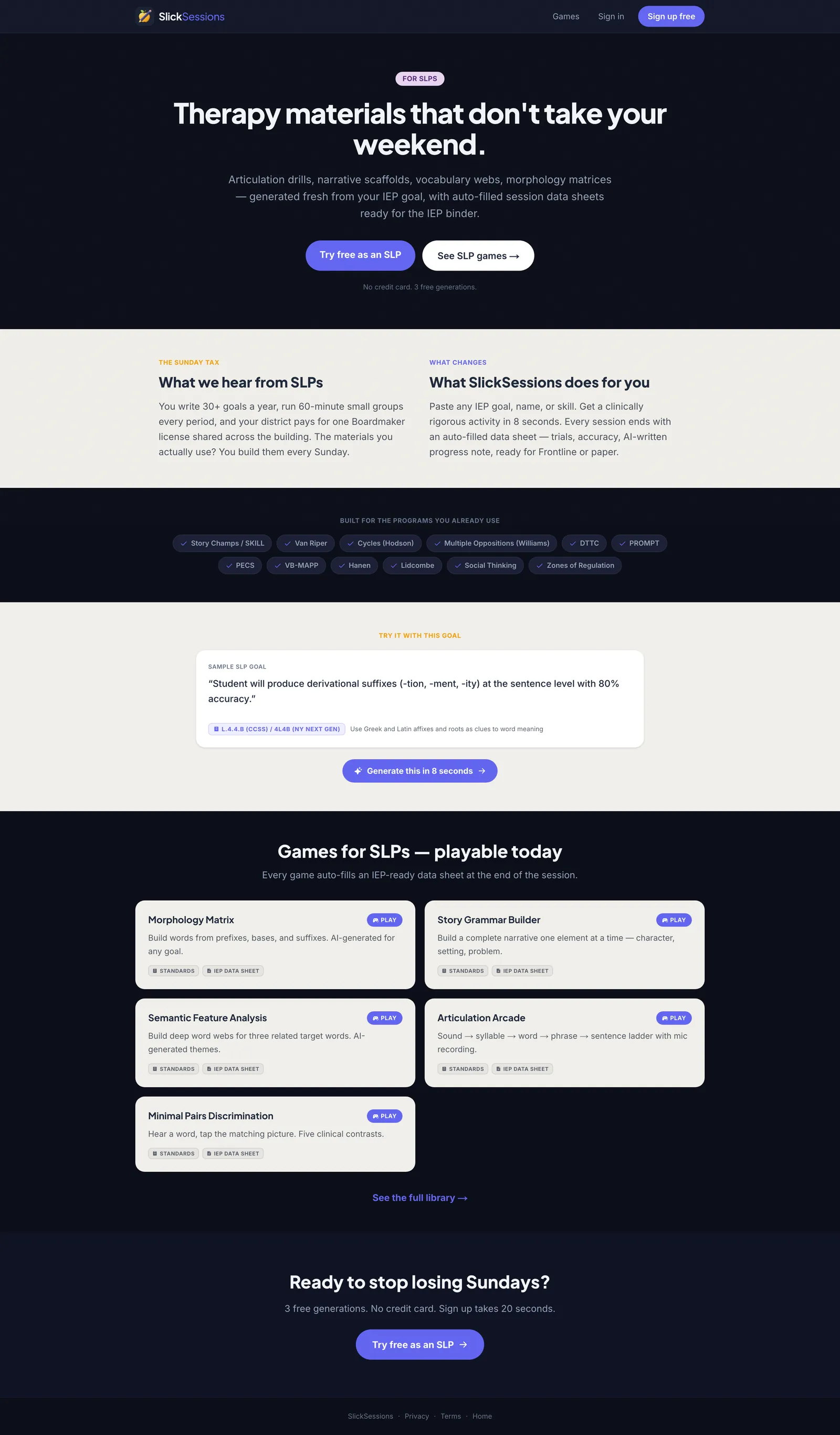
/for/slp
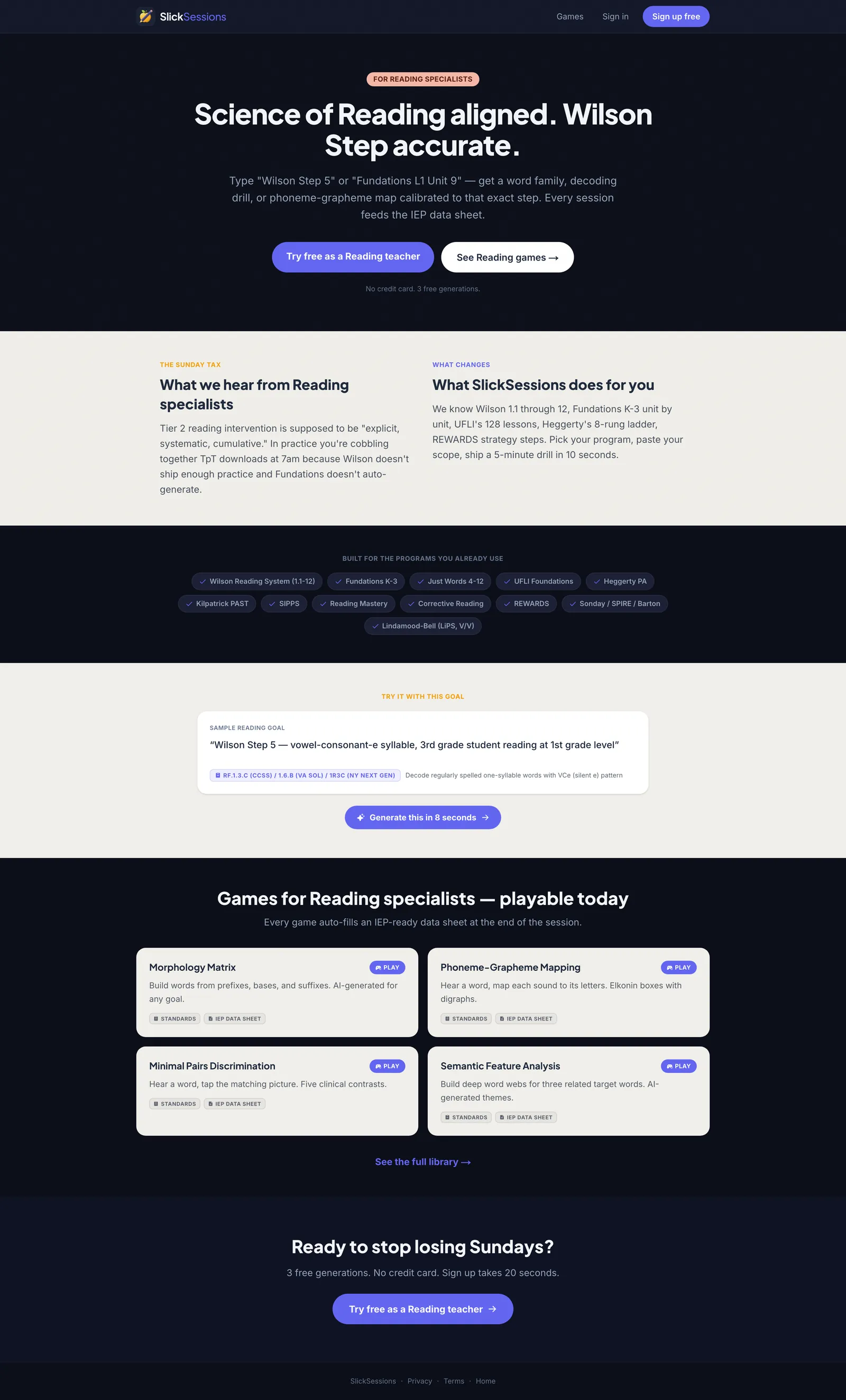
/for/reading
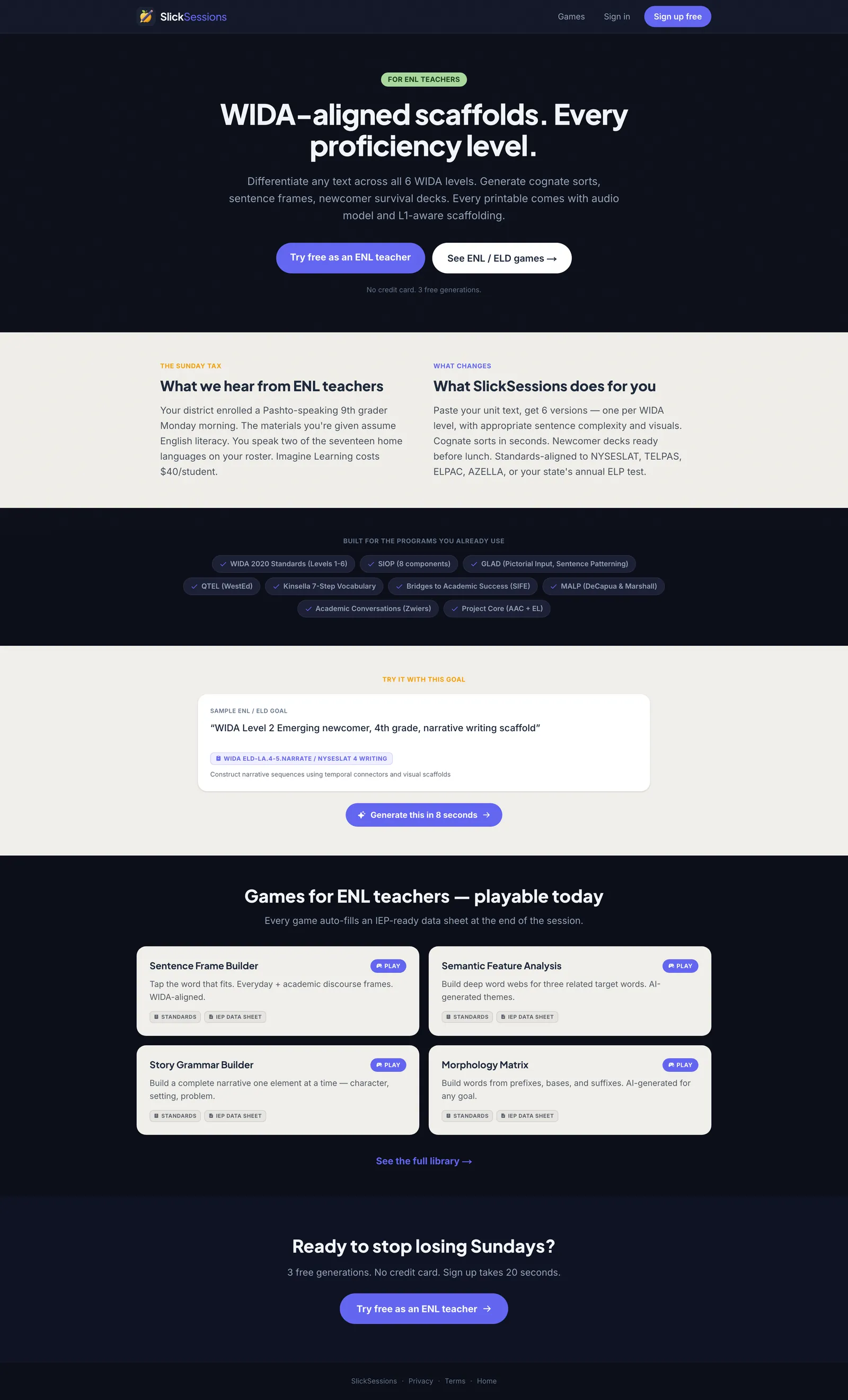
/for/enl
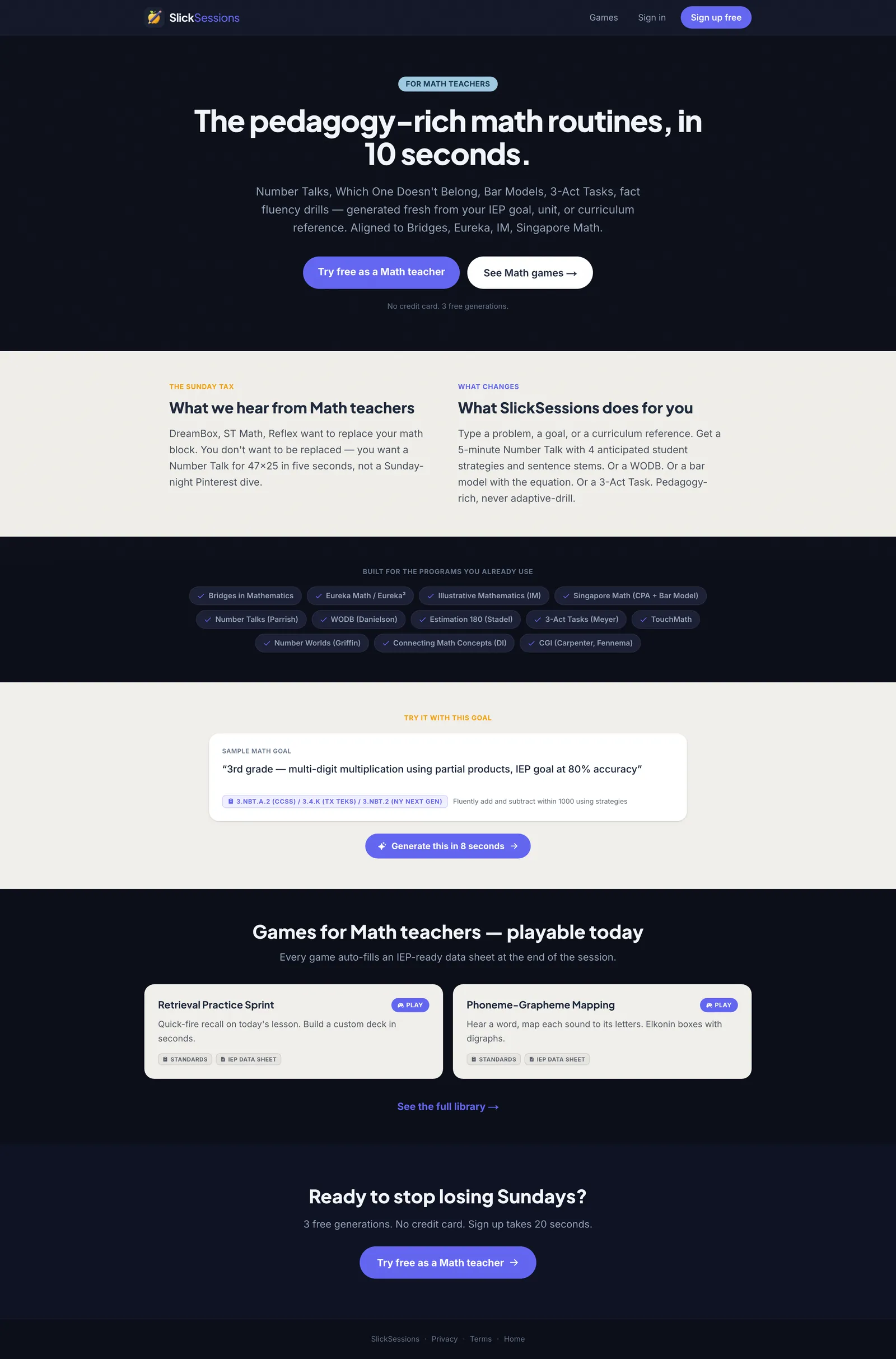
/for/math
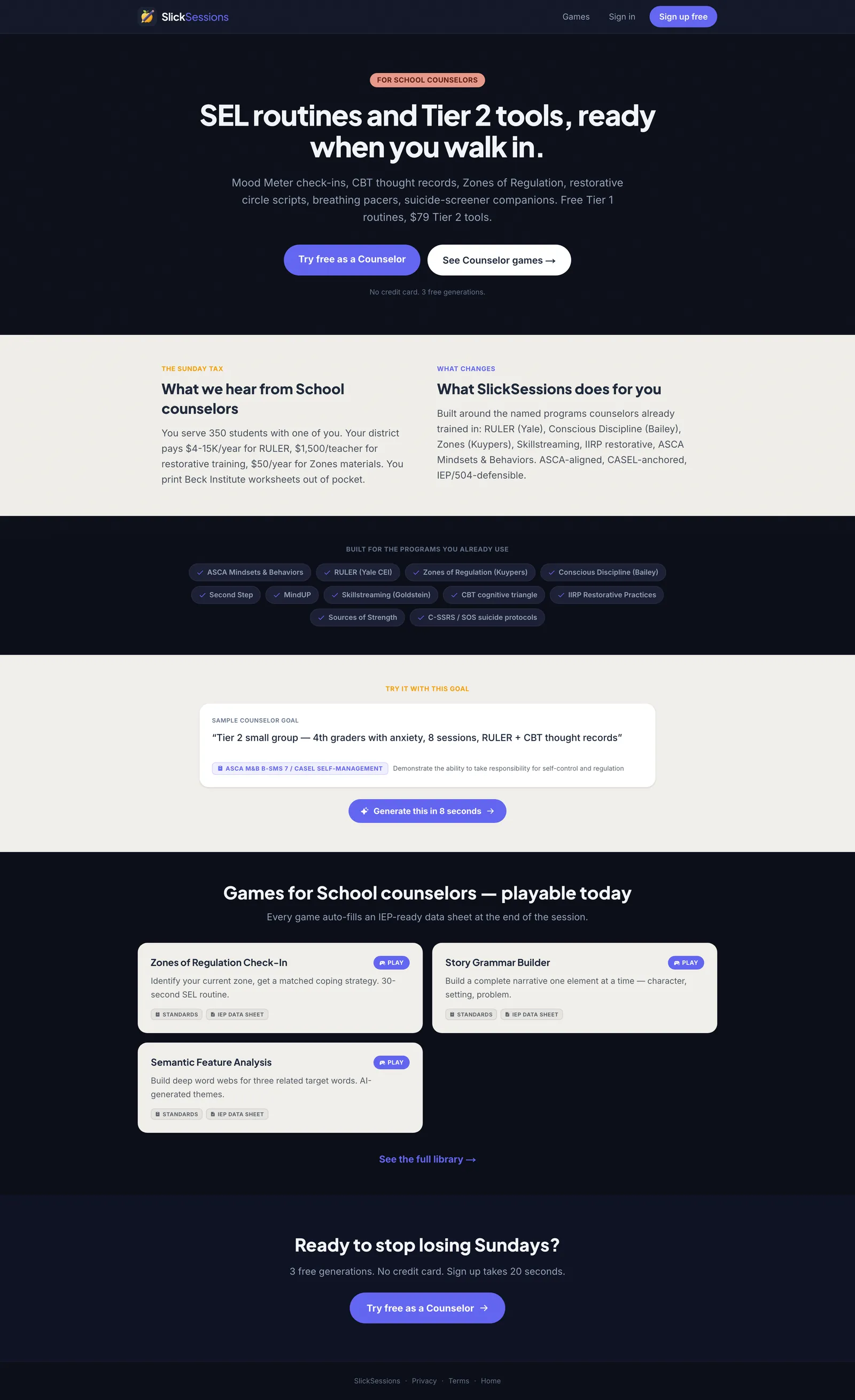
/for/counselor
Visual Foundation
Color Palette
Typography Scale
Component Specs
Final Design
SlickSessions is not a chat box for teachers. It is intervention infrastructure: 23 games and tools, one shared DataSheet, one unified curricula brain, all wired into a closed loop where every practice session feeds the next. Every artifact is state-aligned, IEP-ready, and produced in seconds through carefully scoped AI prompts.
23 Games & Tools Across 7 Roles
Heart Word Hunter for Wilson and Fundations decoding, Story Grammar Builder for narrative language, Cognate Sort and WIDA Differentiator for ENL, Number Talks for math, Worry Window and Calm Down Corner for counseling, First-Then Boards and Token Boards for SPED. Every game captures clean intervention data without the teacher lifting a pen.
The Closed Loop
A student plays Heart Word Hunter for 8 minutes. The DataSheet captures latency and accuracy per word. The PLAAFP Drafter pulls those data points into a draft Present Levels statement, cited and state-tagged. The NextStepsPanel reads the draft and recommends three games for next session — Sound Wall Sort, Heart Word Hunter (next deck), and Phoneme-Grapheme Mapping. The teacher clicks one button, ships the IEP page, and walks into Monday with the next session already planned.
Documentation Engine
PLAAFP Drafter writes IEP Present Levels statements from real data. Progress Note Generator handles MTSS Tier 2/3, tutoring, and practice notes. Multilingual Parent Letter Generator drafts and translates into 10 home languages — Spanish, Mandarin, Vietnamese, Arabic, Haitian Creole, Russian, Korean, Bengali, Tagalog, Pashto. Three letter types × three tones × ten languages = 90 polished letter variants per click.
Public Free Wedge
The free PLAAFP Rewriter takes a teacher's rough PLAAFP draft and returns a polished version with cited gaps and suggestions — no signup, full SEO metadata. Built as the wedge for the highest-intent search query in special ed: earn trust on the free tool, and the paid platform is one click away.
Curricula Brain v2
A 22,000-token cached system reference recognizing every major intervention program by name — Wilson Steps 1-9, Fundations K-3, Heggerty, UFLI, PECS Phases, VB-MAPP, Zones of Regulation, RULER, BRIEF, WIDA, ASCA mindsets. When a teacher types 'Wilson Step 5,' the platform respects closed syllables, consonant doubling, and the program's specific scope and sequence — not generic phonics.
50-State Standards System
Every artifact surfaces the user's state-specific framework. New York gets Next Gen, Texas gets TEKS, Florida gets B.E.S.T., Virginia gets SOL. CCSS is gone unless the state actually uses it. The StatePicker appears on first session and updates the entire platform.
The Small Joy: Mistakes Are Safe
When a student misses a word in Heart Word Hunter, the card doesn't flash red, doesn't make a sad sound, doesn't shake. It logs the miss silently to the DataSheet and shows the next card. Every interaction was designed for the kid who shuts down at the first error — because that kid is in every special ed caseload. The teacher gets the data. The student gets to keep playing. The fact that 'mistakes are safe' is invisible to the user is the point — it's the absence of friction, not the presence of a feature.
Decision Points
Every decision was filtered through one question: would a special ed teacher with 60 students on her caseload use this at 9pm on a Sunday — and would it actually save her tomorrow?
Should this be a single-purpose SLP tool or a platform for every educator?
Stay narrow as TalkingSlick SLP — the original positioning, easier to market, less scope risk
Rebrand to SlickSessions and expand to all 7 K-12 specialist roles (Special Ed, SLP, Reading, ENL, Math, Counselor, School Psych)
Real user feedback in the first month said the gap is bigger than just SLPs. The same teacher writes IEP goals on Monday, sends parent letters on Tuesday, and runs Tier 2 reading intervention on Wednesday. Building 7 vertical tools beats building 7 separate apps. The curricula brain — a 22,000-token reference covering Wilson, Fundations, Heggerty, Zones, BRIEF, WIDA, RULER, PECS — becomes the moat across every role.
Should games stand alone, or be part of a connected workflow?
Ship games as one-off practice activities (the MagicSchool / Diffit pattern — long menu of disconnected tools)
Build a closed loop: practice generates data, data writes the IEP/MTSS documentation, documentation recommends the next 3 games to play
Disconnected tools force teachers to retype student names, re-enter goals, and write the documentation themselves. The closed loop makes every minute of student practice automatically usable in the IEP, the parent letter, and the next session plan. This is the LTV multiplier — 2.5-5x baseline edtech retention.
Should there be a free, no-signup public tool?
Gate every feature behind signup to maximize email capture
Ship a free public PLAAFP Rewriter with no auth — full SEO metadata, do one thing perfectly, link to the paid platform at the end
PLAAFP statements are the most-Googled IEP search term. A free tool that nails it ranks for thousands of long-tail intents and earns trust before asking for an email. SEO compounds; paywalls don't.
How should accessibility be handled?
Meet basic compliance and ship — the users are educators, not students with disabilities
Full WCAG 2.2 AA compliance with neurodivergent-inclusive design throughout
10-15% of educators have ADHD, dyslexia, or other processing differences. Beyond that, the materials they generate are used with students who have IEPs. The product has to model the inclusion it preaches: prefers-reduced-motion respected globally, every input labeled, 4.5:1 minimum contrast, skip-to-content links on every page, one primary action per screen.
From SLP Tool to Intervention Infrastructure
SlickSessions started development in October 2025 as TalkingSlick SLP — a single-purpose SLP material generator. Pre-launch user testing surfaced that the same educators were copy-pasting our SLP outputs into Google Docs because they needed the same depth for IEP goals, ENL letters, and reading intervention. The April 8 pivot to SlickSessions added 6 specialist roles, 22 new games and tools, the closed-loop architecture, the public SEO wedge, and a brand framing — 'intervention infrastructure for IEPs and MTSS' — that no competitor occupies.
October 2025 — Started building TalkingSlick SLP
Single text box, single role (SLP), 12 material types. Built solo as the first product to prove the 'one sentence in, print-ready packet out' pattern that would later become the SlickSessions core.
April 8–9, 2026 — SlickSessions rebrand and public launch (the user-fit failure that drove the pivot)
Pre-launch testing surfaced a strategic problem: the SLP-only positioning was the wrong slice. Early users were specialists who write IEP goals (right TYPE of user) but they ran multiple roles in one job — copy-pasting outputs into Google Docs to use across reading, ENL, and SPED workflows. April 8 pivoted to SlickSessions: expanded to 7 educator roles, built dynamic system prompts per role and grade band, synthesized 8 deep-research agents into the v1 curricula brain. Launched publicly April 9 — 49 signups in the first 48 hours validated the new positioning.
April 21 — Games Night
Shipped 7 playable games in one session. Auto-login on signup closed a 40% activation leak. First evidence that the platform could shift from 'AI text generator' to 'AI-powered practice + data + documentation engine.'
April 25 — Massive Ship Day
Curricula brain v2 (22k cached tokens), 50-state standards system, DataSheet auto-fill on all games, /api/session-summary endpoint, 7 dedicated /for/[role] landing pages, Print-Blank tools, Games/Tools hub split, three production deploys in one day.
April 26 — Closed Loop + Public Wedge
Shipped 4 new games (Heart Word Hunter, WIDA Differentiator, Cognate Sort, Number Talks), 4 new tools (PLAAFP Drafter, Multilingual Parent Letter, Progress Note, public PLAAFP Rewriter), Recommend-Next API closing the practice → documentation → next-session loop, ProgressGraph component, NextStepsPanel, MTSS / target-skill copy update across all role pages. 23 total games and tools built by end of day (a fifth game, WODB, was held back — see below).
What Didn't Ship (and Why That's the Bar)
Which One Doesn't Belong (WODB), the math reasoning game, generates weak rationales ~60% of the time after four rounds of prompt engineering. It is not in the production hub. The decision to hold features back is part of the product — disconnected tools that almost work are the failure mode of every AI EdTech competitor (generating 80 tools at 40% quality). The bar at SlickSessions is the opposite: ship fewer tools at higher quality, which means accepting that some features stay in the WIP folder for weeks. WODB ships when the rationales pass the same quality bar as the games already in production. Holding the line on quality is design judgment, not slowness.
Results & Outcomes
SlickSessions launched publicly in April 2026 — 49 educator signups in the first 48 hours validated the platform; 60 educator signups to date. The product is a 7-role closed-loop intervention engine: 23 games and tools, 50-state standards coverage, multilingual parent letters in 10 languages, all WCAG 2.2 AA accessible. IEPs are legally mandated documents in a regulated setting — what SlickSessions really ships is compliance-grade documentation infrastructure for practitioners who get audited on it. A single Product Designer, building with Claude Code through a structured brain of prompts, briefs, and tested workflows, produced the kind of product depth and shipping velocity that traditionally requires a Series A team and 6 months of runway. The closed-loop architecture is the LTV moat no competitor has shipped.
The lesson from SlickSessions is that depth wins over breadth in 2026. MagicSchool has 80+ tools and 40% classroom-readiness. SlickSessions has 23 deeply-scoped games and tools, all wired into one student profile, all aligned to the user's actual state framework, all connected by the closed loop. Teachers don't want more tools. They want one tool that knows the program they're already running and writes the documentation they're already losing weekends to. This is what 'AI for teachers' is supposed to mean.